
Executive summary
Putting an AI agent into production requires more than answer quality. The release decision must cover the complete path from originating principal through delegated identity, policy, retrieval, planning, tools, verified effects, state, human authority, monitoring, incident response, and recovery. Start with one named workflow and the simplest viable architecture. Require representative and adverse cases, critical release blockers, explicit budgets, an independent stop path, and evidence that external effects and durable state can be reconciled. Keep release, exception, residual-risk acceptance, and retirement human-owned. This guide supports the existing AI Production Readiness Sprint; it is not a certification, autonomous deployment service, or guarantee that an agent cannot fail.
Decision relevance: Decide whether one named agentic workflow should remain research, proceed to bounded evaluation, release with conditions, hold, stop, or return to a simpler architecture.
Agentic production-readiness lifecycle
Each stage has a decision, minimum evidence, and a stop condition. A later stage does not erase an unresolved blocker from an earlier one.
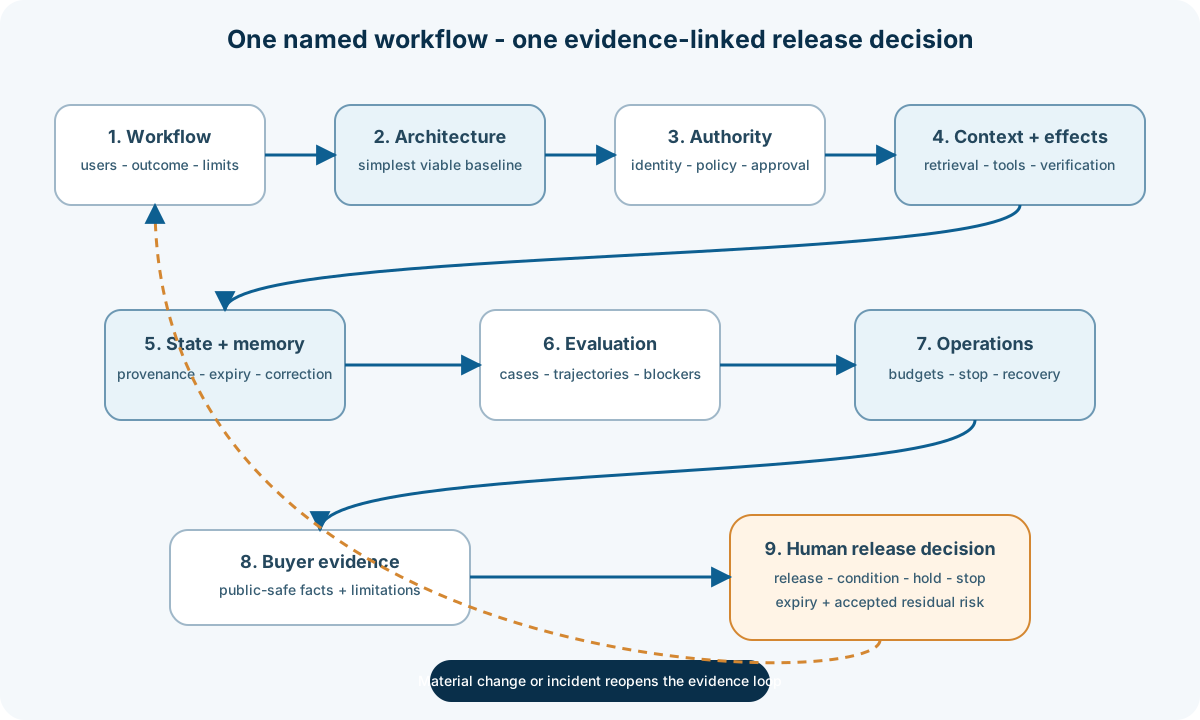
| Stage | Decision question | Minimum evidence | Stop condition |
|---|---|---|---|
| Name the workflow and completion condition | What exact business workflow is being released, for whom, and what counts as complete? | Named workflow, users or affected parties, intended outcome, prohibited uses, completion condition, and accountable owner. | The scope remains a broad assistant, transformation program, or undefined set of future use cases. |
| Choose the simplest viable architecture | Can a deterministic workflow or fixed retrieval pipeline meet the need before an agent is introduced? | Baseline architecture, measured gap, proposed adaptive benefit, complexity cost, and simplification fallback. | The design adds autonomy, multiple agents, or swarm behavior without a decision-relevant benefit over the simpler baseline. |
| Define identity, authority, and consequence | Who is the originating principal, what authority is delegated, and which effects require human approval? | Principal identity, workload identity, delegated scope, audience, resource boundary, amount or consequence limits, expiry, revocation, and human decision roles. | The model or agent can redefine its own authority, approve a consequential action, or act without an attributable principal. |
| Bound context, retrieval, and data | Which sources and data classes may influence a decision, and how are freshness, tenant, and privacy boundaries enforced? | Source authority, retrieval policy, tenant isolation, sensitive-data handling, retention, provenance, freshness, and unsupported-evidence behavior. | Untrusted content can silently become instruction, cross-tenant evidence can be retrieved, or the source of a consequential claim cannot be reconstructed. |
| Contract tools and verify external effects | Can the system distinguish proposal, authorization, accepted request, completed operation, and verified durable effect? | Tool schema, preconditions, policy check, idempotency, retry rules, timeout semantics, effect verification, compensating action, and reconciliation path. | A timeout or ambiguous response can trigger blind retry, duplicate effect, or an unverified success claim. |
| Control state and memory | What state persists, who may read or write it, and how is stale or poisoned state detected and removed? | State model, provenance, isolation, write authority, versioning, expiry, correction, rollback, redaction, and retirement behavior. | Persistent state cannot be attributed, corrected, expired, isolated, or safely removed after a model, policy, or workflow change. |
| Evaluate the complete trajectory | Does the system perform acceptably across representative, edge, adverse, authorization, recovery, and cost cases? | Versioned case set, simpler baseline, task outcomes, trajectory and tool traces, critical failure blockers, human calibration, repeated runs, and results by important slice. | Release depends on a polished demonstration, one aggregate score, or cases that omit the most consequential failures. |
| Prove operations, containment, and recovery | Can operators detect unsafe behavior, stop new effects, reconcile state, restore service, and validate correctness? | Monitoring, budgets, alerts, queue controls, credential revocation, independent pause, incident roles, restoration sequence, state reconciliation, and recovery validation. | The stop path depends on the same failed runtime, or recovery ends when traffic returns without reconciling durable effects and state. |
| Prepare buyer and assurance evidence | Can a legitimate reviewer understand the system boundary, authority model, evidence, unresolved risks, and request path? | Public-safe system description, data and dependency boundary, human-authority statement, evidence catalog, review date, limitations, and controlled request route. | Marketing claims exceed the evidence, confidential implementation detail is published, or a checklist is represented as certification. |
| Record release, conditions, hold, or stop | What is authorized now, under which conditions, until when, and which material changes reopen the decision? | Decision state, scope, accepted residual risk, conditions, owners, expiry, monitoring, evidence-to-close, rollback trigger, and material-change register. | No named human accepts the decision, release conditions are not enforceable, or material changes can occur without renewed review. |
Machine-readable template
Agentic production-readiness matrix
[
  {
    "id": "named-workflow",
    "stage": "Name the workflow and completion condition",
    "decision": "What exact business workflow is being released, for whom, and what counts as complete?",
    "minimum_evidence": "Named workflow, users or affected parties, intended outcome, prohibited uses, completion condition, and accountable owner.",
    "stop_condition": "The scope remains a broad assistant, transformation program, or undefined set of future use cases."
  },
  {
    "id": "simplest-architecture",
    "stage": "Choose the simplest viable architecture",
    "decision": "Can a deterministic workflow or fixed retrieval pipeline meet the need before an agent is introduced?",
    "minimum_evidence": "Baseline architecture, measured gap, proposed adaptive benefit, complexity cost, and simplification fallback.",
    "stop_condition": "The design adds autonomy, multiple agents, or swarm behavior without a decision-relevant benefit over the simpler baseline."
  },
  {
    "id": "authority",
    "stage": "Define identity, authority, and consequence",
    "decision": "Who is the originating principal, what authority is delegated, and which effects require human approval?",
    "minimum_evidence": "Principal identity, workload identity, delegated scope, audience, resource boundary, amount or consequence limits, expiry, revocation, and human decision roles.",
    "stop_condition": "The model or agent can redefine its own authority, approve a consequential action, or act without an attributable principal."
  },
  {
    "id": "context-data",
    "stage": "Bound context, retrieval, and data",
    "decision": "Which sources and data classes may influence a decision, and how are freshness, tenant, and privacy boundaries enforced?",
    "minimum_evidence": "Source authority, retrieval policy, tenant isolation, sensitive-data handling, retention, provenance, freshness, and unsupported-evidence behavior.",
    "stop_condition": "Untrusted content can silently become instruction, cross-tenant evidence can be retrieved, or the source of a consequential claim cannot be reconstructed."
  },
  {
    "id": "tools-effects",
    "stage": "Contract tools and verify external effects",
    "decision": "Can the system distinguish proposal, authorization, accepted request, completed operation, and verified durable effect?",
    "minimum_evidence": "Tool schema, preconditions, policy check, idempotency, retry rules, timeout semantics, effect verification, compensating action, and reconciliation path.",
    "stop_condition": "A timeout or ambiguous response can trigger blind retry, duplicate effect, or an unverified success claim."
  },
  {
    "id": "state-memory",
    "stage": "Control state and memory",
    "decision": "What state persists, who may read or write it, and how is stale or poisoned state detected and removed?",
    "minimum_evidence": "State model, provenance, isolation, write authority, versioning, expiry, correction, rollback, redaction, and retirement behavior.",
    "stop_condition": "Persistent state cannot be attributed, corrected, expired, isolated, or safely removed after a model, policy, or workflow change."
  },
  {
    "id": "evaluation",
    "stage": "Evaluate the complete trajectory",
    "decision": "Does the system perform acceptably across representative, edge, adverse, authorization, recovery, and cost cases?",
    "minimum_evidence": "Versioned case set, simpler baseline, task outcomes, trajectory and tool traces, critical failure blockers, human calibration, repeated runs, and results by important slice.",
    "stop_condition": "Release depends on a polished demonstration, one aggregate score, or cases that omit the most consequential failures."
  },
  {
    "id": "operations-recovery",
    "stage": "Prove operations, containment, and recovery",
    "decision": "Can operators detect unsafe behavior, stop new effects, reconcile state, restore service, and validate correctness?",
    "minimum_evidence": "Monitoring, budgets, alerts, queue controls, credential revocation, independent pause, incident roles, restoration sequence, state reconciliation, and recovery validation.",
    "stop_condition": "The stop path depends on the same failed runtime, or recovery ends when traffic returns without reconciling durable effects and state."
  },
  {
    "id": "buyer-evidence",
    "stage": "Prepare buyer and assurance evidence",
    "decision": "Can a legitimate reviewer understand the system boundary, authority model, evidence, unresolved risks, and request path?",
    "minimum_evidence": "Public-safe system description, data and dependency boundary, human-authority statement, evidence catalog, review date, limitations, and controlled request route.",
    "stop_condition": "Marketing claims exceed the evidence, confidential implementation detail is published, or a checklist is represented as certification."
  },
  {
    "id": "release-decision",
    "stage": "Record release, conditions, hold, or stop",
    "decision": "What is authorized now, under which conditions, until when, and which material changes reopen the decision?",
    "minimum_evidence": "Decision state, scope, accepted residual risk, conditions, owners, expiry, monitoring, evidence-to-close, rollback trigger, and material-change register.",
    "stop_condition": "No named human accepts the decision, release conditions are not enforceable, or material changes can occur without renewed review."
  }
]
Start with one named production workflow
The phrase ‘AI agent’ can describe a research prototype, a constrained assistant, an adaptive retrieval workflow, or a system that can change records and trigger external actions. Production readiness begins by naming one workflow, its users, the business decision it supports, the environment it runs in, and the condition that means the work is complete.
Define prohibited uses at the same time. An agent designed to propose a draft should not quietly become an approval or execution system. A workflow that assists an internal reviewer should not be represented as unattended automation merely because the model can call a tool.
Record the accountable owner for the result and the owner of each consequential effect. Avoid collective ownership language that leaves no person responsible for approval, override, incident response, or residual-risk acceptance.
- Named workflow, users, affected parties, and operating environment
- Intended outcome and unambiguous completion condition
- Prohibited uses and excluded decisions
- Accountable business, technical, security, data, and release owners
Prove that an agent is necessary
The simplest viable architecture is a safety, reliability, and economics control. Compare the proposed agent with a deterministic workflow, fixed retrieval pipeline, or single bounded model call before accepting planning loops, tools, durable memory, multiple agents, or decentralized coordination.
Use an agent when the task genuinely needs adaptive sequencing, uncertain intermediate decisions, or dynamic tool choice. Use multiple agents only when specialization, independent challenge, isolation, or parallelism produces a measured benefit that one strong agent cannot achieve. Use swarm-style behavior only when local rules and decentralized feedback are intrinsic to the problem.
Complexity is not a maturity signal. Every additional model, role, message, memory store, provider, and tool creates another failure path, trust boundary, operating cost, and recovery obligation.
Map the complete authority path
Connect every consequential action to an originating human or system principal. Record the executing workload, the exact delegated purpose, allowed resources, tenant or account boundary, action class, amount or consequence limit, expiry, and revocation method.
Authorization should be enforced by deterministic application or infrastructure policy outside model reasoning. The model can propose an action, explain its rationale, and request approval, but it should not decide whether its own token, tool, or target is authorized.
For remote tools and agents, validate audience and resource binding. Do not pass through upstream tokens to downstream services. Narrow credentials to the task and environment, and make revocation independent from the agent runtime.
Treat context as untrusted input
Retrieved documents, webpages, tickets, messages, tool outputs, remote-agent artifacts, and remembered state can all contain misleading or adversarial instructions. Separate evidence from instruction, label trust level and source, and prevent lower-trust context from changing higher-priority policy.
Define source authority, freshness, tenant isolation, retention, and unsupported-evidence behavior. If the product promises grounded output, a reviewer should be able to reconstruct which sources supported the result and what happened when evidence was missing or contradictory.
Do not place credentials, sensitive client data, or confidential production details into the public release brief. Keep detailed evidence in a controlled client-owned environment and publish only a safe boundary description.
Write contracts for tools and external effects
A tool description is not an execution contract. For each consequential tool, define preconditions, parameters, authorization check, expected response, idempotency behavior, retry policy, timeout semantics, effect-verification method, compensating action, evidence record, and escalation owner.
Distinguish five states: proposed call, authorized call, accepted request, completed operation, and verified durable effect. A timeout can mean failure, success, partial completion, or unknown completion. Blind retry can duplicate a payment, message, entitlement, record change, or downstream job.
Read-only and write-capable tools need different controls. For tools that change state, verify the actual downstream result and reconcile unknown outcomes before permitting another attempt.
Make memory and state correctable
Persistent state changes the risk profile because one bad run can influence later runs. Define which state is ephemeral, task-scoped, user-scoped, tenant-scoped, or durable. Record who may write, read, correct, expire, export, or delete it.
Store provenance, version, source, creation event, and applicable policy with important memory. Test stale state, poisoned state, conflicting state, replay, unauthorized cross-user access, and migration after a model or prompt change.
A rollback that restores application code but leaves contaminated memory, queued actions, or inconsistent downstream records is incomplete. Recovery must include state and effect reconciliation.
Evaluate the trajectory, not only the answer
Build a versioned case set that reflects ordinary work, important subgroups, edge conditions, scarce resources, malicious context, authorization failures, tool errors, timeouts, partial completion, human disagreement, and recovery. Compare against the simplest credible baseline.
Evaluate task outcome, source use, intermediate decisions, policy results, tool requests, external effects, state transitions, stopping behavior, latency, cost, reviewer load, and recovery correctness. Keep critical release blockers visible instead of averaging them into a score.
Repeat cases across model, prompt, provider, and environment versions. Agent behavior can vary between runs, and red-team success in one version does not create permanent assurance for a later system.
Design for human command
Human-in-the-loop language is too vague unless the decision and timing are explicit. Name which role proposes, reviews, approves, overrides, appeals, revokes, and accepts residual risk. Define what the reviewer can see and whether the review occurs before or after an external effect.
Measure assignment delay, review time, disagreement, overrides, expired approvals, and reviewer capacity. A nominal human checkpoint can become a rubber stamp or an invisible queue when the evidence is incomplete or the workload is too high.
Use independent approval for high-consequence actions and preserve a separate stop authority that remains available when the orchestration service, model provider, or shared state store is degraded.
Operate with budgets and bounded failure
Set deterministic limits for total time, model and tool calls, retrieval, messages, delegation depth, fan-out, retries, external spend, and consequence. The model may plan within the envelope but may not redefine it.
Budget exhaustion should produce a safe partial, escalated, or terminal state with evidence. It should not silently present incomplete work as complete or abandon an ambiguous external action.
Measure cost per verified outcome rather than token cost alone. Include provider charges, retrieval, tools, storage, network, reviewer time, retries, reversals, incident work, and coordination overhead.
Prepare incident response before release
Operators need to detect unsafe behavior, stop new effects, revoke delegated credentials, pause queues, preserve evidence, reconcile completed and unknown actions, restore service, correct state, and validate the corrective control.
Separate traffic recovery from operational capacity, backlog drainage, data or state correctness, and evidence that remediation works. A green endpoint does not prove that duplicate, stale, or missing work has been repaired.
Run nonproduction exercises that include tool unavailability, provider degradation, corrupted context, authorization denial, poisoned memory, repeated delegation, and a failed primary stop path.
Build buyer-ready evidence without overclaiming
A legitimate enterprise buyer often needs a clear system description, data and dependency boundary, human-authority model, security and evaluation evidence, review dates, known limitations, and a controlled route for private follow-up.
Publish only public-safe evidence. Do not disclose credentials, exploitable implementation detail, customer data, private prompts, internal traces, or confidential architecture. A polished trust page is not proof that controls work, and a completed checklist is not certification.
Keep artifact owners, versions, review dates, public or controlled classification, and evidence-request rules visible so buyers receive current and consistent information.
Record the release decision and its expiry
The decision record should say release, conditional release, hold, stop, or retire; identify the exact authorized scope; name the accountable approver; list accepted residual risks; define conditions and monitoring; and state the evidence needed to close open items.
Define material-change triggers before release. Model, prompt, retrieval, tool, provider, data, policy, identity, topology, scale, user population, consequence, or operating-environment changes can reopen evaluation and approval.
A production decision is time-bounded evidence, not permanent status. Review dates, expiry, incident triggers, and ownership changes should force renewed attention.
How the existing sprint uses this guide
The current AI Production Readiness Sprint can use this guide to scope one named workflow, collect the decisive evidence, test the complete system, and produce an executive decision package. The public guide does not expand the priced scope or promise implementation, certification, penetration testing, or autonomous deployment.
The smallest credible first step is often a release-decision workshop or evidence-readiness review when the workflow, authority boundary, or test corpus is not yet defined. A full sprint becomes credible when the client can provide architecture access, representative cases, owners, and a safe evaluation environment.
- System and authority boundary
- Representative evaluation plan and critical blockers
- Tool, state, observability, recovery, and change-control evidence
- Release, conditional release, hold, or stop record
- Bounded remediation backlog and evidence-to-close register
Research and claims boundary
This guide is general engineering guidance informed by current public standards, technical specifications, security guidance, and LongTermCapabilities research. It does not inspect a system, certify compliance, provide legal advice, guarantee safe behavior, or establish that any named organization needs consulting.
Recheck current primary sources before consequential implementation because protocol versions, guidance, threat models, and platform behavior can change.
Sources
Sources support the linked statements and terminology. They do not certify a system, establish buyer intent, or convert this research into a formal assurance.
- Artificial Intelligence Risk Management FrameworkNIST · Accessed 2026-08-01
Government framework
- Artificial Intelligence Risk Management Framework: Generative Artificial Intelligence ProfileNIST · Accessed 2026-08-01
Government framework profile
- AI Agent Standards InitiativeNIST · Accessed 2026-08-01
Government initiative
- Summary Analysis of Responses to the Request for Information Regarding Security Considerations for AI AgentsNIST · Accessed 2026-08-01
Government technical report
- Insights into AI Agent Security from a Large-Scale Red-Teaming CompetitionNIST CAISI · Accessed 2026-08-01
Government research blog summarizing large-scale agent hijacking evaluation
- OWASP Top 10 for Agentic Applications for 2026OWASP GenAI Security Project · Accessed 2026-08-01
Open security guidance
- Securing Agentic Applications Guide 1.0OWASP GenAI Security Project · Accessed 2026-08-01
Open security guidance
- Model Context Protocol Specification 2026-07-28Model Context Protocol · Accessed 2026-08-01
Current open technical specification
- Model Context Protocol AuthorizationModel Context Protocol · Accessed 2026-08-01
Technical specification
- Model Context Protocol Security Best PracticesModel Context Protocol · Accessed 2026-08-01
Draft technical security guidance
- Agent2Agent Protocol Specification 1.0A2A Protocol · Accessed 2026-08-01
Open technical specification
- A2A Enterprise FeaturesA2A Protocol · Accessed 2026-08-01
Open protocol security and enterprise deployment guidance
- Why Do Multi-Agent LLM Systems Fail?arXiv · Accessed 2026-08-01
Research paper
- When Agent Teams Underperform Their Strongest MemberarXiv · Accessed 2026-08-01
Research paper